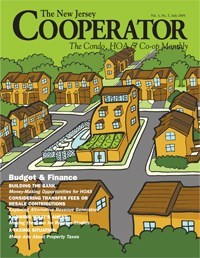

Money-Making Opportunities for HOAs
It's a profound story of how reserve funds can go seriously awry—within months of buying an apartment in a new New York City building, David and all his new neighbors were informed that they would have to contribute out-of-pocket to help build the co-op's reserve fund. Each shareholder would have to pony up a month's worth of additional fees—which for David meant over $1,000. Final total: the residents coughed up around $45,000 to put aside just in case something went wrong. Read More
New Jersey's Property Tax Reform Process
Most homeowners love complaining about their property tax bills almost as much as they despise paying them.
The issue is always on the minds of New Jersey's homeowners, and has been for some time. New Jersey has been studying property tax reform for three decades, since the establishment of the Tax Policy Committee under former Governor William T. Cahill in 1972. The idea of a constitutional convention to reform property taxes was first raised in 2000 by then Sen. William E. Schluter.
Read MoreTransfer Fees or Resale Contributions
In New York City, many co-ops and condos use a practice called a "flip tax" in order to boost building revenue. A flip tax is a fee paid either by the purchaser or seller that goes back to the co-op or condo each time an apartment is sold, or "flipped." In New Jersey, the concept of the flip tax exists in several forms, but the term "flip tax" is almost never used. Read More
Making the Case for Reserve Studies
In the archives of sound financial advice, saving for a rainy day is a titan, right up there with never bet your last dollar on a horse race, or any other sage old saying. For the good health of any organization, having enough cash in reserve to handle just about any and all problems is imperative. Knowing how much you will need for that rainy day provides even better protection. Read More
Cutting Budget Waste
In any business, much of the decision-making process is based on the bottom line—is there more money coming in or going out? How do this year's profits compare with last year's? Are we getting the best deals from suppliers and vendors? While homeowner associations aren't necessarily concerned with making huge profits, they are businesses, and all businesses want to operate in the most economical way possible and hopefully increase in value as time goes by. In order to maintain a high level of operating efficiency and increase the worth of your HOA, examination of the bottom line is crucial, just like it is with big businesses. Read More
The Role of Your HOA Accountant
David Allen Stockman, former director of the U.S. Office of Management and Budget, may have had the federal budget in mind when he said that, "None of us really understands what's going on with all of these numbers." But he might just as easily have been talking about condominium and townhome budgets, as well. Read More
Passing Inspection
It's a long-held truism that, when considering any major purchase, it's up to the consumer to be informed—to do his or her homework before signing on the dotted line. The phrase caveat emptor loosely translates to "Buyer Beware," and while it's applicable to everything from washing machines to used cars, it's especially true when it comes to buying a home. Read More
A Look at Paterson
It's a point of pride for many Northern New Jerseyans that their part of the state was home to some of the most compelling chapters in American history, industry, and social change. Of the many small cities with a deep connection to that history and heritage, Paterson, on the banks of the Passaic River, is not one to be overlooked. Read More